Sunday, March 22, 2009

OPEN LETTER: March 17, 2009

OPEN LETTER: March 17, 2009

Several decades ago, I said to myself: “We have a service economy in which we make nothing and this is not going to work for long” - and now it is worse with almost everything we buy made overseas. If it weren't for the farmers and our food products, we could not survive. So our new con-man Madoff-man President, in a reverse Ponzi scheme, prints a trillion dollars and distributes it, making friends with everybody--and now we have money again. Of course all that money is going to go overseas also because we still don't make much over here worth buying... except food. Nothing has changed except printing more money. With all this money finding its way out of the United States, we are all going to be broke again in another year or so. The incredibly selfish business men responsible for all this outsourcing of factories, technology and jobs ought to be shot as traitors--they obviously did not give a damn about America--they literally SOLD OUT America. So, how many years in a row can the con-man Madoff-man President print trillions of dollars? Who is kidding who? We need to reestablish our industries and not only “buy” but “produce” American! Printing money and being Mr. Wonderful is not going to do it.


Samuel A. Nigro, M.D.

Monday, October 27, 2008

Never forget, Hard Truth

I received this email today:

General Eisenhower Warned Us


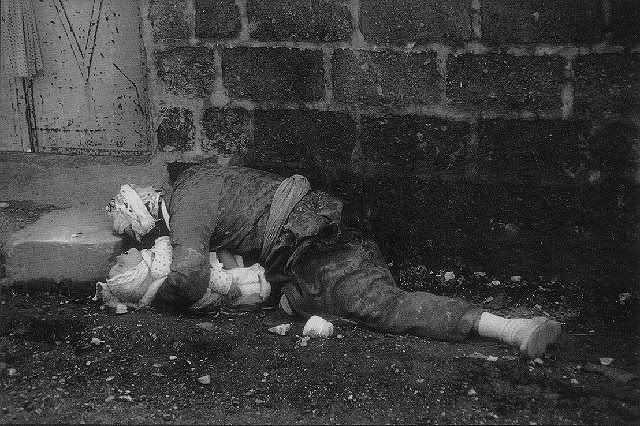
It is a matter of history that when the Supreme Commander of the Allied Forces, General Dwight Eisenhower, found the victims of the death camps he ordered all possible photographs to be taken, and for the German people from surrounding villages to be ushered through the camps and even made to bury the dead.

He did this because he said in words to this effect:


'Get it all on record now - get the films - get the witnesses -because somewhere down the road of history some bastard will get up and say that this never happened'

This week, the UK debated whether to remove The Holocaust from its school curriculum because it 'offends' the Muslim population which claims it never occurred. It is not removed as yet. However, this is a frightening portent of the fear that is gripping the world and how easily each country is giving into it.


It is now more than 60 years after the Second World War in Europe ended. This e-mail is being sent as a memorial chain, in memory of the,6 million Jews, 20 million Russians, 10 million Christians, and 1,900 Catholic priests


Who were 'murdered, raped, burned, starved, beat, experimented on and humiliated' while the German people looked the other way!

Now, more than ever, with Iran , among others, claiming the Holocaust to be 'a myth,' it is imperative to make sure the world never forgets.


This e-mail is intended to reach 400 million people! Be a link in the memorial chain and help distribute this around the world.

How many years will it be before the attack on the World Trade Center ..

'NEVER HAPPENED'


My question to you, is how much do you REALLY care about genocide? Are you willing to tolerate it, or ignore it?

I would propose to you the following: If Hitler had stayed within the boundaries of Germany and Czechoslovakia, would the world have gone to war with him to stop him from the extermination of the people of God and his enemies? I would hazzard a guess that he'd have been "tolerated" just as the world tolerates every other dictator who committed genocide against his people; be it the Soviets (Ukraine), Turks (Armenians), or Darfur, Sudan, Rwanda, and all the other places which have been turned into living hell. No, Hitler would have eliminated the Jews from his country, and Chamberlain and the west would have given him Poland and who knows how much of Europe, had he not gotten impatient.

You don't think so? Search the history of the 30s, the 40s. Try and find a voice speaking out for the Jews of Germany in this country, advocating going to war to save them, even when we were at war. You will come up empty(1). the silence of Roesevelt is deafening. No, the international community speaks of rights, and offers pious plattitudes about "Never again" but the reality is, sanctity of borders is of far more importance than sanctity of life.

Oh, yes, there is one genocidal dictator that was taken out by military action; but for some reason, we've forgotten that and are now upset by the violation of that dicatators' borders! C'est la vie, c'est la mort;


What was that you said? "Never again?"


"Never again?"

"Never again?"

"Never again?"

Unless you mean it, never say never again, unless you are willing to back it up.
hypocrite. see if the name fits.

Here is Mexican actor Eduardo Verastegui speaking about the genocide of his people occuring with the USA.


Eduardo Verastegui continues with

"and my answer is the same that they give in schools about showing movies of the Nazi holocaust. Teachers don't show these videos in order to emotionally manipulate students. They snow them because the Nazi holocaust represents a terrible evil that words alond cannot describe. The holocaust of abortion is no different. We all instinctively know abortion is something evil and it is something so terrible that we can't even see it, shouldn't we perhaps not tolerate it either?

Yet, at this moment, Eduardo's video has been banned on YouTube, and his web site is unreachable. It would seem that we are destined to remain in darkness.


They who die today, will be there to convict us on judgment day.


(1) see:
The Holocaust in American Life, Peter Novick (2000)
Selling the Holocaust: From Auschwitz to Schindler, How History is Bought, Packaged and Sold, Tim Cole (1999)

Sunday, October 12, 2008

From the Back Cover
"Here is a book with a thousand memories for those of us who came of political age while living through urban riots, the Vietnam War, and the Nixon years. Norman Solomon, one of America's most respected progressive voices, gets personal in this account of living through the age of Vietnam, Nixon, tie-dye T shirts, girlfriends, and even the music that will forever waft through the minds of those of us who were there. Those of us who, like journalist Solomon, will never forget it." ***Phil Donahue


America declared war on God and wonders why there is no peace. well, duh.
The usual apologetic; we didn't succeed because we didn't go far enought. I'd venture to say that if we didn't go "far enough" it's probably why we are all still breathing.

Thursday, July 17, 2008

No smoking hot spot

From The Australian

No smoking hot spot

David Evans July 18, 2008

I DEVOTED six years to carbon accounting, building models for the Australian Greenhouse Office. I am the rocket scientist who wrote the carbon accounting model (FullCAM) that measures Australia's compliance with the Kyoto Protocol, in the land use change and forestry sector.

FullCAM models carbon flows in plants, mulch, debris, soils and agricultural products, using inputs such as climate data, plant physiology and satellite data. I've been following the global warming debate closely for years.

When I started that job in 1999 the evidence that carbon emissions caused global warming seemed pretty good: CO2 is a greenhouse gas, the old ice core data, no other suspects.

The evidence was not conclusive, but why wait until we were certain when it appeared we needed to act quickly? Soon government and the scientific community were working together and lots of science research jobs were created. We scientists had political support, the ear of government, big budgets, and we felt fairly important and useful (well, I did anyway). It was great. We were working to save the planet.

But since 1999 new evidence has seriously weakened the case that carbon emissions are the main cause of global warming, and by 2007 the evidence was pretty conclusive that carbon played only a minor role and was not the main cause of the recent global warming. As Lord Keynes famously said, "When the facts change, I change my mind. What do you do, sir?"

There has not been a public debate about the causes of global warming and most of the public and our decision makers are not aware of the most basic salient facts:

1. The greenhouse signature is missing. We have been looking and measuring for years, and cannot find it.

Each possible cause of global warming has a different pattern of where in the planet the warming occurs first and the most. The signature of an increased greenhouse effect is a hot spot about 10km up in the atmosphere over the tropics. We have been measuring the atmosphere for decades using radiosondes: weather balloons with thermometers that radio back the temperature as the balloon ascends through the atmosphere. They show no hot spot. Whatsoever.

If there is no hot spot then an increased greenhouse effect is not the cause of global warming. So we know for sure that carbon emissions are not a significant cause of the global warming. If we had found the greenhouse signature then I would be an alarmist again.

When the signature was found to be missing in 2007 (after the latest IPCC report), alarmists objected that maybe the readings of the radiosonde thermometers might not be accurate and maybe the hot spot was there but had gone undetected. Yet hundreds of radiosondes have given the same answer, so statistically it is not possible that they missed the hot spot.

Recently the alarmists have suggested we ignore the radiosonde thermometers, but instead take the radiosonde wind measurements, apply a theory about wind shear, and run the results through their computers to estimate the temperatures. They then say that the results show that we cannot rule out the presence of a hot spot. If you believe that you'd believe anything.

2. There is no evidence to support the idea that carbon emissions cause significant global warming. None. There is plenty of evidence that global warming has occurred, and theory suggests that carbon emissions should raise temperatures (though by how much is hotly disputed) but there are no observations by anyone that implicate carbon emissions as a significant cause of the recent global warming.

3. The satellites that measure the world's temperature all say that the warming trend ended in 2001, and that the temperature has dropped about 0.6C in the past year (to the temperature of 1980). Land-based temperature readings are corrupted by the "urban heat island" effect: urban areas encroaching on thermometer stations warm the micro-climate around the thermometer, due to vegetation changes, concrete, cars, houses. Satellite data is the only temperature data we can trust, but it only goes back to 1979. NASA reports only land-based data, and reports a modest warming trend and recent cooling. The other three global temperature records use a mix of satellite and land measurements, or satellite only, and they all show no warming since 2001 and a recent cooling.

4. The new ice cores show that in the past six global warmings over the past half a million years, the temperature rises occurred on average 800 years before the accompanying rise in atmospheric carbon. Which says something important about which was cause and which was effect.

None of these points are controversial. The alarmist scientists agree with them, though they would dispute their relevance.

The last point was known and past dispute by 2003, yet Al Gore made his movie in 2005 and presented the ice cores as the sole reason for believing that carbon emissions cause global warming. In any other political context our cynical and experienced press corps would surely have called this dishonest and widely questioned the politician's assertion.

Until now the global warming debate has merely been an academic matter of little interest. Now that it matters, we should debate the causes of global warming.

So far that debate has just consisted of a simple sleight of hand: show evidence of global warming, and while the audience is stunned at the implications, simply assert that it is due to carbon emissions.

In the minds of the audience, the evidence that global warming has occurred becomes conflated with the alleged cause, and the audience hasn't noticed that the cause was merely asserted, not proved.

If there really was any evidence that carbon emissions caused global warming, don't you think we would have heard all about it ad nauseam by now?

The world has spent $50 billion on global warming since 1990, and we have not found any actual evidence that carbon emissions cause global warming. Evidence consists of observations made by someone at some time that supports the idea that carbon emissions cause global warming. Computer models and theoretical calculations are not evidence, they are just theory.

What is going to happen over the next decade as global temperatures continue not to rise? The Labor Government is about to deliberately wreck the economy in order to reduce carbon emissions. If the reasons later turn out to be bogus, the electorate is not going to re-elect a Labor government for a long time. When it comes to light that the carbon scare was known to be bogus in 2008, the ALP is going to be regarded as criminally negligent or ideologically stupid for not having seen through it. And if the Liberals support the general thrust of their actions, they will be seen likewise.

The onus should be on those who want to change things to provide evidence for why the changes are necessary. The Australian public is eventually going to have to be told the evidence anyway, so it might as well be told before wrecking the economy.

Dr David Evans was a consultant to the Australian Greenhouse Office from 1999 to 2005.

Tuesday, February 5, 2008

Tragedies Versus Statistics

In a collection of essays by former Marxists called The God That Failed, poet Stephen Spender drew attention to his own hypocrisy in the matter:

"When I saw photographs of children murdered by the Fascists, I felt furious pity. When the supporters of Franco talked of Red atrocities, I merely felt indignant that people should tell such lies. In the first case I saw corpses; in the second only words. I gradually acquired a certain horror of the way in which my own mind worked. It was clear to me that unless I cared about every murdered child impartially, I did not really care about children being murdered at all."


From CWNews, Tragedies Versus Statistics

SB 1520 (2005) and closed minds

When confronted with the fact that the 2005 so-called "human cloning ban" bill co-sponsored by Hillary Clinton and Barak Obama (SB 1520), does no such thing, but rather mandates the killing of human clones after their production, here's the response of one individual who prefers to close his mind to truth, instead of follow his own advice and investigate the facts:


It bans cloning. You can't make a human by moving the embryonic cell to a uterus, and this bill mandates that you may not do this, no matter what the source of the uterus is. That is prohibition! Your understanding of the process is incomplete and convoluted. The NRTL's is too! I thoroughly believe that the NRTL's intent is to get you to vote Republican, and that they'll resort to playing stupid. What this bill says, in effect, is that it's not okay to allow people who can't have children to get them through embryonic transplantation [of a clone, legally produced under this bill]. It does not prohibit in vitro fertilization. It prohibits moving the embryo to any uterous.

I have no more time for this nonsense! I've already decided how I'm gonna vote. I'm voting for sanity and reason! There seems to be way too little of both.

Whatever it is, whether I agree with it or not, I don't wanna hear anybody's opinion. I don't wanna hear things about abortion, gun legislation, immigration, or anything. Don't send me yours. I won't send you mine. I can't deal with the stress. I have enough of my own.

All future correspondence relating to politics will go into my Ignore email folder for immediate deletion.

OK, demand thinking, then refuse to, and finally cut off intelligent discourse.


SB-1520 is an excellent example of crass missrepresentation; follow the fun!


http://thomas.loc.gov/cgi-bin/bdquery/z?d109:s.01520:
-------------------------------------------------------------


Human Cloning Ban Act of 2005 (Introduced in Senate)
S 1520 IS
109th CONGRESS
1st Session
S. 1520
To prohibit human cloning.
IN THE SENATE OF THE UNITED STATES
July 27, 2005

`Sec. 301. Prohibition on human cloning

`(a) Prohibitions on Human Cloning- It shall be unlawful for
any person or other legal entity, public or private--

`(1) to conduct or attempt to conduct human cloning;

On the face of it, this seems to vindicate the claim that the National Right to Life Committee erred in stating that Sens. Obama and Clinton support cloning via this bill. However, if you
continue with the text of the bill, you will find:

`(e) Definitions- In this section:

`(1) HUMAN CLONING- The term `human cloning' means implanting or attempting to implant the product of nuclear transplantation into a uterus or the functional equivalent of a uterus.


You see the obvious point that the National Right to Life Committee has made, that this bill, in spite of it's name, does no such thing as ban cloning of humans; it renames "human cloning" to "nuclear transplantation" and then redefines human cloning to something that it is not (Orwell's 1984 is just behind schedule). When all is said and done, the bill simply demands that there be no attempt for clones not be brought to birth by any means; there is no prohibition on cloning, because cloning has been redefined to exclude the actual process of cloning! the only thing prohibited is so-called "reproductive cloning."

In point of fact, this bill expressly permits the creation of cloned human beings:


`(b) Protection of Research- Nothing in this section shall be
construed to restrict practices not expressly prohibited
in this section.

It effectively requires that they be killed. read this part very carefully, because this is the redefinition of what is actually human cloning; it is the slight-of-hand that is the establishment of a new legal-fiction:


`(3) NUCLEAR TRANSPLANTATION- The term `nuclear transplantation'means transferring the nucleus of a human somatic cell into an oocyte from which the nucleus or all chromosomes have been or will be removed or rendered inert.

Section 301(2) makes this painfully clear by prohibiting the creation of an interstate or export trade in clones created in the US for further gestation.


`(2) to ship the product of nuclear transplantation in
interstate or foreign commerce for the purpose of
human cloning in the United States or elsewhere; or

So in this bill, a clone is now "The product of nuclear transplantation."

Friday, January 11, 2008

Historical/Political questionaire

Not original with me, but borrowed from a trusted friend. If you don't know the answer make your best guess.

Who said it?

1) "We're going to take things away from you on behalf of the common good."

A. Karl Marx
B. Adolph Hitler
C. Joseph Stalin
D. None of the above

2) "It's time for a new beginning, for an end to government of the few, by the few, and for the few…… And to replace it with shared responsibility for shared prosperity."

A. Lenin
B. Mussolini
C. Idi Amin
D. None of the Above

3) "(We) .can't just let business as usual go on, and that means something has to be taken away from some people."

A. Nikita Khrushev
B. Josef Goebbels
C. Boris Yeltsin
D. None of the above

4) "We have to build a political consensus and that requires people to give up a little bit of their own … in order to create this common ground."

A. Mao Tse Dung
B. Hugo Chavez
C. Kim Jong Il
D. None of the above

5) "I certainly think the free-market has failed."

A. Karl Marx
B. Lenin
C. Molotov
D. None of the above

6) "I think it's time to send a clear message to what has become the most profitable sector in (the) entire economy that they are being watched."

A. Pinochet
B. Milosevic
C. Saddam Hussein
D. None of the above

You will find the Answers in the first Comment below.

Tuesday, December 11, 2007

A Two'fer

Atheists Attacking Religion With Signs Depicting Twin Towers to Mark Holiday Season..


IMAGINE REDUX


To be just, judge religion on its effects on the man who has followed it,
not the man who is impervious to it.

Wednesday, November 14, 2007

Archbishop Chaput on Citizenship and Evangelization

lifted article

"We're Better Americans by Being More Truly Catholic"


NEW YORK, NOV. 5, 2007 (Zenit) - Here is the address Archbishop Charles Chaput of Denver delivered Oct. 26 at St. John's University School of Law in Queens, New York. The talked is titled "Church and State Today: What Belongs to Caesar, and What Doesn't."

* * *

I always enjoy being with friends like tonight because I can leave my Kevlar vest in Denver. I do a lot of speaking, and while most of the people I meet are wonderful folks, not everyone is always happy to hear what I have to say.

In fact, one of the distinguishing marks of debate both outside and within the Church over the last 40 years is how uncivil the disagreements have become. Being a faithful Catholic leader today -- whether you're a layperson or clergy -- isn't easy. It requires real skill, and in that regard, I've admired the great ability and good will of Bishop Murphy for many years. So it's a special pleasure to be with him tonight. New York's Cardinal Edward Egan is another leader who's given extraordinary and sometimes difficult service to the Church.

I'm not really surprised by the environment in our country or in our Church because Msgr. George Kelly saw it coming 30 years ago. I read his great book, "The Battle for the American Church," as a young Capuchin priest when it first came out in 1979. I remember being struck immediately by George's very Irish combination of candor, scrappiness, clarity, intelligence and also finally charity -- because everything he wrote and said and did was always motivated by his love for the Church.

I also remember George's sense of humor, which was vivid and healthy, and which probably kept him so generous and sane. He was a man's man and a priest's priest -- and his commitment to Catholic family life, Catholic education and Catholic scholarship has remained with me as an example throughout my priesthood. George and I became friends through our mutual friend Father Ronald Lawler, O.F.M. Cap., and after I became a bishop in South Dakota, he would often call me or write me with his advice -- and I was always happy to get it, because it was always very good. So I'm grateful for a chance to acknowledge my debt to him.

We have a full evening, so I'll be very brief. I want to quickly sketch for you the picture of an anonymous culture. But everything I'm about to tell you comes from the factual record.

This society is advanced in the sciences and the arts. It has a complex economy and a strong military. It includes many different religions, although religion tends to be a private affair or a matter of civic ceremony.

This particular society also has big problems. Among them is that fertility rates remain below replacement levels. There aren't enough children being born to replenish the current adult population and to do the work needed to keep society going. The government offers incentives to encourage people to have more babies. But nothing seems to work.

Promiscuity is common and accepted. So are bisexuality and homosexuality. So is prostitution. Birth control and abortion are legal, widely practiced, and justified by society's leading intellectuals.

Every now and then, a lawmaker introduces a measure to promote marriage, arguing that the health and future of society depend on stable families. These measures typically go nowhere.

Ok. What society am I talking about? Our own country, of course, would broadly fit this description. But I'm not talking about us.

I've just outlined the conditions of the Mediterranean world at the time of Christ. We tend to idealize the ancients, to look back at Greece and Rome as an age of extraordinary achievements. And of course, it was. But it had another side as well.

We don't usually think of Plato and Aristotle endorsing abortion or infanticide as state policy. But they did. Hippocrates, the great medical pioneer, also famously created an abortion kit that included sharp blades for cutting up the fetus and a hook for ripping it from the womb. We rarely connect that with his Hippocratic Oath. But some years ago, archeologists discovered the remains of what appeared to be a Roman-era abortion or infanticide "clinic." It was a sewer filled with the bones of more than 100 infants.

If you haven't done so already, I'd encourage you to pick up a little book written about 10 years ago, "The Rise of Christianity" by the Baylor University scholar Rodney Stark. You'll find all of this history in its pages and more.

But what does ancient Rome have to do with my topic tonight, the relationship of Church and state today?

Let me explain it this way: People often say we're living at a "post-Christian" moment. That's supposed to describe the fact that Western nations have abandoned or greatly downplayed their Christian heritage in recent decades. But our "post-Christian" moment actually looks a lot like the pre-Christian moment. The signs of our times in the developed nations -- morally, intellectually, spiritually and even demographically -- are uncomfortably similar to the signs in the world at the time of the Incarnation.

Drawing lessons from history is a subjective business. There's always the risk of oversimplifying.

But I do believe that the challenges we face as American Catholics today are very much like those faced by the first Christians. And it might help to have a little perspective on how they went about evangelizing their culture. They did such a good job that within 400 years Christianity was the world's dominant religion and the foundation of Western civilization. If we can learn from that history, the more easily God will work through us to spark a new evangelization.

I'm not a historian or a sociologist, so I'll leave it to others to fully evaluate Rodney Stark's work. But Stark does address a couple of key questions: How did Christianity succeed? How was it able to accomplish so much so fast? Stark is not only a social scientist, but also a self-described agnostic. So he has no interest in talking about God's will or the workings of the Holy Spirit. He focuses only on facts he can verify.

Stark concludes that Christian success flowed from two things: first, Christian doctrine, and second, people being faithful to that doctrine. Stark writes: "An essential factor in the [Christian] religion's success was what Christians believed. ... And it was the way those doctrines took on actual flesh, the way they directed organizational actions and individual behavior, that led to the rise of Christianity."

Let's put it in less academic terms: The Church, through the Apostles and their successors, preached the Gospel of Jesus Christ. People believed in the Gospel. But they weren't just agreeing to a set of ideas. Believing in the Gospel meant changing their whole way of thinking and living. It was a radical transformation. So radical they couldn't go on living like the people around them anymore.

Stark shows that one of the key areas in which Christians rejected the culture around them was marriage and the family. From the start, to be a Christian meant believing that sex and marriage were sacred. From the start, to be a Christian meant rejecting abortion, infanticide, birth control, divorce, homosexual activity and marital infidelity -- all those things widely practiced by their Roman neighbors.

Athenagoras, a Christian layman, told the Emperor Marcus Aurelius in the year A.D. 176 that abortion was "murder" and that those involved would have to "give an account to God." And he told the emperor the reason why: "For we regard the very fetus in the womb as a created being, and therefore an object of God's care."

As this audience already knows, Christian reverence for the unborn child is no medieval development. It comes from the very beginnings of our faith. The early Church had no debates over politicians and communion. There wasn't any need. No persons who tolerated or promoted abortion would have dared to approach the Eucharistic table, let alone dared to call themselves true Christians.

And here's why: The early Christians understood that they were the offspring of a new worldwide family of God. They saw the culture around them as a culture of death, a society that was slowly extinguishing itself. In fact, when you read early Christian literature, practices like adultery and abortion are often described as part of "the way of death" or the "way of the [devil]."

There's an interesting line in a Second Century apologetic work written by Minucius Felix. He was a Roman lawyer and a convert. He's talking about a birth-control drug that works as an abortifacient. He describes its effects this way: "There are women who swallow drugs to stifle in their own womb the beginnings" of a person to be.

That's what the first Christians saw around them in their world. They believed the world was snuffing out its own future. It was stifling future generations before they could come to be. It was slowly killing itself.

Since we see similar signs in our own day, we need to find the courage those first Christians had in challenging their culture. We need to believe not only what they believed. We need to believe those things with the same deep fervor.

The early Christians staked their lives on the belief that God is our Father. They respected Caesar, but they didn't confuse him with God, and they put God first. They believed the Church is our mother. They believed their bishops and priests were spiritual fathers and that through the sacraments they were made children of God, or "partakers of the divine nature," as Peter said.

It's time for all of us who claim to be "Catholic" to recover our Catholic identity as disciples of Jesus Christ and missionaries of his Church. In the long run, we serve our country best by remembering that we're citizens of heaven first. We're better Americans by being more truly Catholic -- and the reason why, is that unless we live our Catholic faith authentically, with our whole heart and our whole strength, we have nothing worthwhile to bring to the public debates that will determine the course of our nation.

Pluralism in a democracy doesn't mean shutting up about inconvenient issues. It means speaking up -- respectfully, in a spirit of justice and charity, but also vigorously and without apologies. Jesus said that we will know the truth, and the truth will make us free. He didn't say anything about our being popular with worldly authority once we have that freedom. In the end, if we want our lives to be fruitful, we need to know ourselves as God intends us to be known -- as his witnesses on earth, not just in our private behavior, but in our public actions, including our social, economic and political choices.

If pagan Rome could be won for Jesus Christ, surely we can do the same in our own world. What it takes is the zeal and courage to live what we claim to believe. All of us here tonight already have that desire in our hearts. So let's pray for each other, and encourage each other, and get down to the Lord's work.

Thursday, May 31, 2007

Bishop Vasa speaks


Documented, undocumented -- our citizenship is in heaven
03/01/2007 Bishop Robert Vasa


It will come as no surprise that the weekend entailed a bit of travel. Friday required me to be in Portland for an afternoon meeting and on Saturday and Sunday I needed to be in Milton-Freewater and Athena and on Monday I needed to be back in Bend. I did not keep a close record of the miles but it appears to be something in excess of 600 miles. Fortunately they were great days for travel. Unfortunately they would also have been great days not to travel. I could not help but be amused upon driving into Milton-Freewater to discover a rather prevalent frog theme. A number of the businesses have positioned anthropomorphic frogs such as a four foot frog dressed as a dentist, an accountant, a reader at the library, some shoppers and even a frog lineman positioned twelve feet up on a power pole. They struck me as both quite clever and delightful. I must admit, however, that I have not yet discerned the connection between Milton-Freewater and frogs. I have a hard time imagining that the local High School mascot is a frog but then again one never knows.

My purpose, of course, in coming to Milton-Freewater and to Athena was to administer the Sacrament of Confirmation. The class at Athena was small, being comprised of four members. There was also one First Communicant. The youngsters were quite well catechized which was a good thing because, since there were only four of them, each one needed to respond to several questions. The First Communicant was likewise given an opportunity to answer a couple of questions about Confession and Holy Eucharist. It was most delightful.

The class at Milton-Freewater was considerably larger and the Church was jammed to overflowing. It has been my experience that when a small community has a rather large Sacramental class it is usually true that a vast majority of that class will be Hispanic. This is certainly the case in Milton-Freewater. In this class of 46 confirmands I estimate that more than 40 were of Hispanic descent. I did not attempt to determine the legality or the illegality of the immigration or worker status of the families connected with these young people but it is something about which I know there is much concern. In terms of the Church we recognize a universal membership. A person baptized Catholic in Mexico is just as much a Catholic as someone baptized in the United States. As St. Paul says, our citizenship is in heaven. As fellow citizens in this one overarching kingdom of God we must be careful that our legitimate concerns about national security and unregulated borders do not cause us to think or act in a way unbefitting this primary citizenship. I suspect that there may be a significant number of Catholic Hispanics within our own diocese who are counted among the 10 - 12 million undocumented residents. That status, which some describe as criminal, deprives them of the tranquility which we enjoy, it deprives them often-times of the opportunity to be with their families for important familial and holiday celebrations, it deprives them oftentimes of access to the sacraments, most notably marriage. While it can be argued that they came here of their own accord and that they have chosen the good with the bad it is more likely true that they sought some good and overlooked the extent to which that good involved a high personal cost. It is important in our necessary discussions of the status of undocumented workers and residents that we not forget that there are still basic human rights which are not conditioned on citizenship. These basic rights and the Christian principles of justice, mercy, compassion and charity must be afforded to everyone who is our neighbor. The one who is our neighbor in Christ, towards whom Christ requires the extension of the hand of help and friendship, is not necessarily a good person, a well person, an honest person, a sober person; he is only a person in need. The one who is our neighbor in Christ, towards whom Christ requires the extension of the hand of help and friendship, is not necessarily properly documented. He is, nonetheless, our neighbor. This does not mean that we abdicate our social and civil responsibilities but it does mean that we seek to fulfill those responsibilities in a way which does not violate our higher responsibilities to human life and dignity.

It would be a terrible thing indeed if the reason for all of the concern about the presence of undocumented residents is tied more to fear that their presence will detrimentally impact upon our standard of living than it is about legitimate fears about national security. It is true that the legalization of the status of 10 to 12 million undocumented residents will have an impact on our society. I am not at all convinced that this impact will be a bad thing in the light of the eternal realities. I wonder, for instance, how many Confirmations I would have had in Milton-Freewater if there had been no undocumented or improperly documented families participating. I do know that the number would have been very scant if those of relatively recent arrival from Mexico had been excluded. It may well be that a vast majority of these young people are affiliated with families who have no immigration or documentation concerns and that would be wonderful. My fear is that a number of them may not be properly documented and that this is having a very detrimental impact on them, on their families and on their practice of the faith.

Earlier in the week I spent a day at the Powell Butte property studying and working on the irrigation system. I have always been a bit fascinated by wheel line irrigation and since there is a wheel line on the property and since it belongs to the diocese the maintenance likewise falls to the diocese, in this case, me. I think I learned a lot. I also got very wet - several times. In the process I decided that there really was no shortage of water-related recreational possibilities for our summer youth camps. I was reminded of the many summer time Sunday water fights which erupted on the family farm at home which generally involved squirt guns, hoses, buckets, balloons and sprinklers. The end result was very much like the end result of my working on the wheel line - very wet, very cool, well contented. The Milton-Freewater frog would have been right at home.


Copyright 2002-2006, Catholic Sentinel, Portland, Oregon

Friday, April 20, 2007

Thursday, March 22, 2007

Film review: AMAZING GRACE

March 16, 2007

The film Amazing Grace, currently playing in theaters, is a multi-layered story of love and triumph against powerful cultural forces that supported the slave trade in the United Kingdom. On the most basic level, it's the personal story of William Wilberforce, a British Member of Parliament, who championed the abolition of slavery in the UK during the 18th Century. On a deeper level, the film chronicles the cultural conflict between the entrenched evil of the slave trade and the force of the Truth. It is an unabashedly Christian message in our morally ambiguous age.

William Wilberforce, played by Ioan Gruffudd, was only 21 when he was elected to Parliament fresh from Cambridge, where he was graduated in 1780. Soon after entering Parliament he had a profound Christian conversion, and then began a twenty-year crusade against the slave trade. The film chronicles his life from that point on, using long flashbacks to alternate between his early public life and his climatic strugglesto achieve a vote against the slavers.

Wilberforce suffers physically during the second act, and his friends show great care and concern for him by seeing to his medication and encouraging him to rest. As the film progresses, his physical suffering from untreatable colitis seems to parallel the spiritual suffering he underwent trying to convince his countrymen of the evils of the slave trade. The film draws us into the debate as we accompany Wilberforce on a tour of a slave ship, guided by a freedman, Olaudah Equiano (Youssou N'Dour). He describes the brutal conditions of the hold where women were raped, the weak were cast overboard to lighten the load, and death stalked each African slave on the passage. Wilberforce and his friends also arrange for a river "tour" of the harbor for aristocrats, causing them to pass close by a slave ship where they could smell the stench of death emanating therefrom. The capstone for me was the scene where Equiano bares his branded chest and explains, "They give you this so that you know that you no longer belong to God, but to a man."

When his suffering is almost too much to bear, Wilberforce's friends come to the rescue by introducing him to the woman who would be his wife, Barbara Spooner (Romola Garai). She is intelligent and full of life, and, through her, his passion and strength for the cause is renewed. As their love blossoms, we see color return to the screen and the grey of suffering begins to pale. There is one scene in particular that becomes the turning point for his life's work. William and Barbara have spent the entire night talking, he narrating his effort to free the slaves and she encouraging him to go on, when he walks to the window and realizes it has become morning. As the third act begins, he opens the curtains to let the sunrise into the room, and Barbara reminds him, "after the night comes the dawn."

The third act begins with the wedding of Barbara and William, and the story is then completed in a series of scenes depicting the backroom political maneuvering in Parliament. As victory nears, Wilberforce's good humor returns and the story lightens a bit. Clearly his new wife, Barbara, and their children have a positive effect on Wilberforce, even apparently improving his physical condition. At the end, after achieving the political victory with the vote to outlaw slavery throughout the British dominion, he is so recognized for his achievement that even his political adversaries acknowledge his character.

Amazing Grace has a talented supporting cast, including Albert Finney who plays the evangelical preacher, John Newton, author of the popular hymn that lends the movie its name. Newton provides the binding of the film, and in some ways the voice of God, in guiding young Wilberforce to discern how best to serve God. Newton looks him straight in the eye and tells him flatly, "You have work to do." Wilberforce recognizes it as his commission. The rest of the cast is equally spectacular, giving performances both effortless and powerful.

The photography and musical score guide the mood of the film without becoming overbearing, lending credibility to each scene, and immersing the audience in the Britain of 200 years ago.

The film explores a number of themes: the dignity of life, the value of suffering, and the necessity for perseverance for truth, even, with a simple remark by Barbara, of the true end of marriage -- being open to life. I was struck again and again by the parallels between the fight then against the slavers and the fight now against the abortionists. As my dear mother often said, "the more things change, the more they remain the same."

Men of faith like William Wilberforce led the way for the abolitionists, and there was considerable cultural conflict between institutions and groups over the issue in America as well. At one time, the U.S. Postmaster General refused to carry abolitionist publications to the South, teachers with abolitionist beliefs were excluded from Southern schools, and even Harvard, Yale, and Princeton resisted the tide of abolitionist feelings in the North and sided with the slaveholders. Predictably, there was conflict between American Catholics and the Pope over the issue, with some American Catholics dissenting from Pope Gregory XVII's bull In Supremo Apostolatus that forcefully decried slavery and the slave trade as a "disgrace from the whole confines of Christianity" and "utterly unworthy the Christian name." Undoubtedly there were some Catholics, clergy among them, who took the position of "personally opposed" to the issue of the permanent bondage of another man.

Just as the Abolitionists were shouted down by "polite and established society," so the Pro-Life Movement is forced to shout to be heard. Once again, the established institutions of Harvard, Princeton, and Yale are on the wrong side of the issue, supporting the murder of the innocent as "choice." Pro-Life teachers are told to toe the line or loose their jobs, just like those who were sent away from the South in the 1850s. And once again, American Catholics, clergy among them, dissent from the magisterial teachings on the subject.

Just as his predecessor did, the current successor to Peter has spoken clearly to reaffirm the ancient Christian horror at the murder of innocent children. In 2005, Pope Benedict said, "For this reason, it is necessary to help all people to be aware that the intrinsic evil of the crime of abortion, which attacks human life at its beginning, is also an aggression against society itself." [emphasis mine]. Just as with slavery, Benedict knows that to cheapen a single human life cheapens all human life, and abortion most certainly reduces human life to a commodity, a child to mere property that a woman may dispose of as she chooses. Similarly, embryonic stem cell research takes tiny human beings and rips them asunder for their parts as one would disassemble a car for the a spare piston.

Some people on the pro-abortion side call for "compromise" and ask Pro-Life persons to "work together to make abortion rare." But there can be no middle ground in this issue because there is no middle state between life and death. Either a person is alive or they are not ... and innocent life must be defended. It is our responsibility, it is our duty, it is our vocation.

The success of the Abolitionist movement of the 19th Century should give us great hope, for far smaller groups than the Pro-life Movement inspired great progress in the protection of human beings from slavery. The new terrible slavery that grips the land is on the wane, despite what one might hear in "polite society." Two-hundred thousand people marched in Washington's freezing temperatures just a few weeks ago, and thousands more marched in other cities. Pro-Life politicians are being elected, and slowly the unjust laws that condemn men and society to the bondage of death are being rolled back.

It's really only a matter of time now, and I'm very proud to call myself an Abolitionist.

Copyright 2007 Catholic Exchange

Mickey Addison is a career military officer, and has been a catechist at the parish level since 2000. He and his wife have been married for 19 years and they have two children. He can be reached at addisoncrew@gmail.com.

Tuesday, March 20, 2007

The Great Global Warming Swindle

Complete video is available here

March 15, 2007
Global Warming Swindle
By Thomas Sowell (http://www.realclearpolitics.com)

Britain's Channel 4 has produced a devastating documentary titled "The Great Global Warming Swindle." It has apparently not been broadcast by any of the networks in the United States. But, fortunately, it is available on the Internet.

Distinguished scientists specializing in climate and climate-related fields talk in plain English and present readily understood graphs showing what a crock the current global warming hysteria is.

These include scientists from MIT and top-tier universities in a number of countries. Some of these are scientists whose names were paraded on some of the global warming publications that are being promoted in the media -- but who state plainly that they neither wrote those publications nor approved them.

One scientist threatened to sue unless his name was removed.

While the public has been led to believe that "all" the leading scientists buy the global warming hysteria and the political agenda that goes with it, in fact the official reports from the United Nations or the National Academy of Sciences are written by bureaucrats -- and then garnished with the names of leading scientists who were "consulted," but whose contrary conclusions have been ignored.

There is no question that the globe is warming but it has warmed and cooled before, and is not as warm today as it was some centuries ago, before there were any automobiles and before there was as much burning of fossil fuels as today.

None of the dire things predicted today happened then.

The British documentary goes into some of the many factors that have caused the earth to warm and cool for centuries, including changes in activities on the sun, 93 million miles away and wholly beyond the jurisdiction of the Kyoto treaty.

According to these climate scientists, human activities have very little effect on the climate, compared to many other factors, from volcanoes to clouds.

These climate scientists likewise debunk the mathematical models that have been used to hype global warming hysteria, even though hard evidence stretching back over centuries contradicts these models.

What is even scarier than seeing how easily the public, the media, and the politicians have been manipulated and stampeded, is discovering how much effort has been put into silencing scientists who dare to say that the emperor has no clothes.

Academics who jump on the global warming bandwagon are far more likely to get big research grants than those who express doubts -- and research is the lifeblood of an academic career at leading universities.

Environmental movements around the world are committed to global warming hysteria and nowhere more so than on college and university campuses, where they can harass those who say otherwise. One of the scientists interviewed on the British documentary reported getting death threats.

In politics, even conservative Republicans seem to have taken the view that, if you can't lick 'em, join 'em. So have big corporations, which have joined the stampede.

This only enables the green crusaders to declare at every opportunity that "everybody" believes the global warming scenario, except for a scattered few "deniers" who are likened to Holocaust deniers.

The difference is that we have the hardest and most painful evidence that there was a Holocaust. But, for the global warming scenario that is causing such hysteria, we have only a movie made by a politician and mathematical models whose results change drastically when you change a few of the arbitrarily selected variables.

No one denies that temperatures are about a degree warmer than they were a century ago.

What the climate scientists in the British documentary deny is that you can mindlessly extrapolate that, or that we are headed for a climate catastrophe if we don't take drastic steps that could cause an economic catastrophe.

"Global warming" is just the latest in a long line of hysterical crusades to which we seem to be increasingly susceptible.

Correction: Britain's Channel 4 produced the documentary "The Great Global Warming Swindle," not the BBC. References to the BBC have been corrected or removed.

Copyright 2007 Creators Syndicate

Thursday, March 15, 2007

"Religion" of Environmentalism


Czech President: "Religion" of Environmentalism a way of
"masterminding human society from above"
A "New World Order" With Warming "Deniers" Threatened

By John-Henry Westen

LONDON, March 12, 2007 (LifeSiteNews.com) - The general appreciation for taking care of the earth's resources, of being stewards of creation is being exploited to drive a political and even mythological system of environmentalism. The President of the Czech Republic spoke at the Cato Institute Friday calling "environmentalism" a "religion", and warning against the hysteria being generated by 'global warming' enthusiasts."

All of us are very much in favour of maximum environmental protection and protection of nature," said President Vaclav Klaus during a follow-up interview for a Cato podcast. "But it has nothing in common with environmentalism, which is ideological and practically attacking our freedom."

Environmentalism is, he said "a way of introducing new forms of statism, new forms of masterminding human society from above." The Czech President noted that the citizens of his nation experienced communism first hand giving them awareness of agendas of domination. It is, he said, "something we feel very strongly about because our experience with communism gives us very special sensitivity in this respect."

Almost as if on queue, Gordon Brown, likely to replace Tony Blair as the next British prime minister, delivered a speech today calling for a "new world order" to combat global warming. He called on the United Nations to make the fight against global warming a core "pillar" of its international mission.

The warnings of President Klaus come as no surprise to the pro-life movement which has warned for years that Kyoto and similar proposals to counter global warming have at their core a population control agenda.

According to scientists who contest the science behind global warming, the faithful followers of the environmentalist religion do not sanction dissent. Timothy Ball, a former climatology professor at the University of Winnipeg in Canada, told the Sunday Telegraph that he has received five deaths threats by email since raising concerns about the degree to which man was affecting climate change."

I can tolerate being called a sceptic because all scientists should be sceptics, but then they started calling us deniers, with all the connotations of the Holocaust," said Ball. "That is an obscenity. It has got really nasty and personal."

The Telegraph also reports that Richard Lindzen, the professor of Atmospheric Science at Massachusetts Institute of Technology recently stated that: "Scientists who dissent from the alarmism have seen their funds disappear, their work derided, and themselves labelled as industry stooges." Dr Myles Allen, from Oxford University, concurred: "The Green movement has hijacked the issue of climate change. It is ludicrous to suggest the only way to deal with the problem is to start micro managing everyone, which is what environmentalists seem to want to do."

To hear the podcast interview with President Klaus:
President Vaclav Klaus: Environmentalism as Religion

Tuesday, March 13, 2007

Moment of Reckoning

From the March Editorial in "This Rock" magazine

Here at Catholic Answers, we begin every day with Mass celebrated by our chaplain, Fr. Vincent Serpa, O.P. At the “sign of the peace,” Fr. Vincent says, “Peace be with you,’ and we respond “and also with you.” Then he proceeds with the breaking of the host. In other words, we skip the handshaking, hugging, kissing, waving, and peace-sign flashing that is characteristic of most parish Masses.

Although the exchange of a sign of peace among the congregation is optional, most Catholics are not aware of that. That is not surprising given the emphasis on the sign of peace in many parishes. Many people would interpret its omission her as a sign that we don’t care about community or peace.

That’s far from true; we have a genuine Christian community. Nonetheless, we are sinners, and like every other workplace, we have conflicts and tensions. So, I like the omission of the shake, rattle, and roll at our daily Mass. In that moment of silence, with nothing to distract the conscience, any lack of peace resounds like a foghorn.

Moreover, that moment of silence is a fitting metaphor of a Christian understanding of peace. This understanding gets lost in most conversations on the topic.

The world sees peace as something relatively easy to achieve, given the right intervention. But a moment’s consideration will make it obvious that peace is not accomplished by a simple gesture during Mass, let alone by picketing in front of the School of the Americas. Partial peace begins with each of us living lives of heroic virtue.

It is only partial because peace in this life is never fully accomplished. It is never absolute. It cannot be chosen, for example, in the same way chastity or temperance can be chosen because peace is dependent on other people. It is always temporary and always fragile. The world talks as if we could bring about complete and lasting peace by our own efforts. What we long for, however, can be found only in Christ.

In the words of Dietrich von Hildebrand:

We must not seek peace for its own sake, and on no account must we seek any and every kind of peace, but seek God and content ourselves with that peace which He alone can give to our soul. Those restless in the world are nearer to God than those satisfied in the world.
In that tension – the space between the peace we desire and the lack of it which confronts us – we Christians dwell.

Cherie Peacock, Editor, This Rock magazine

Monday, March 5, 2007

The Great Global Warming Swindle

On British TV:

Channel 4 Thursday 8 March at 9pm

In a polemical and thought-provoking documentary, film-maker Martin Durkin argues that the theory of man-made global warming has become such a powerful political force that other explanations for climate change are not being properly aired.


The film brings together the arguments of leading scientists who disagree with the prevailing consensus that a 'greenhouse effect' of carbon dioxide released by human activity is the cause of rising global temperatures.

Instead the documentary highlights recent research that the effect of the sun's radiation on the atmosphere may be a better explanation for the regular swings of climate from ice ages to warm interglacial periods and back again.

The film argues that the earth's climate is always changing, and that rapid warmings and coolings took place long before the burning of fossil fuels. It argues that the present single-minded focus on reducing carbon emissions not only may have little impact on climate change, it may also have the unintended consequence of stifling development in the third world, prolonging endemic poverty and disease.

The film features an impressive roll-call of experts, including nine professors – experts in climatology, oceanography, meteorology, environmental science, biogeography and paleoclimatology – from such reputable institutions as MIT, NASA, the International Arctic Research Centre, the Institut Pasteur, the Danish National Space Center and the Universities of London, Ottawa, Jerusalem, Winnipeg, Alabama and Virginia.

The film hears from scientists who dispute the link between carbon dioxide levels and global temperatures.

'The ice core record goes to the very heart of the problem we have,' says Tim Ball, Climatologist and Prof Emeritus of Geography at the University of Winnipeg in the documentary. 'They said if CO2 increases in the atmosphere, as a greenhouse gas, then the temperature will go up'.

In fact, the experts in the film argue that increased CO2 levels are actually a result of temperature rises, not their cause, and that this alternate view is rarely heard. 'So the fundamental assumption, the most fundamental assumption of the whole theory of climate change due to humans, is shown to be wrong.'

'I've often heard it said that there is a consensus of thousands of scientists on the global warming issue, that humans are causing a catastrophic change to the climate system,' says John Christy, Professor and Director of the Earth System Science Center, NSSTC University of Alabama. 'Well I am one scientist, and there are many, that simply think that is not true.'

The film examines an alternative theory that explains global temperatures, based on research by Professor Eigil Friis-Christensen of the Danish Space Center. The professor and his team found that as solar activity increases, and the sun flares, cloud formation on earth is significantly diminished and temperature rises.

Ian Clark, Professor of Isotope hydrogeology and paleoclimatology at the Dept of Earth Sciences, University of Ottawa explains: 'Solar activity over the last hundred years, over the last several hundred years, correlates very nicely, on a decadal basis, with temperature.'

Finally, the film argues that restricting CO2 emissions could actually be damaging for people in the developing world. James Shikwati, Kenyan director of the Inter Region Economic Network, says: 'The rich countries can afford to engage in some luxurious experimentation with other forms of energy, but for us we are still at the stage of survival.

'I don't see how a solar panel is going to power a steel industry, how a solar panel is going to power a railway network, it might work, maybe, to power a small transistor radio.

'The thing that emerges from the whole environmental debate is the point that there is somebody keen to kill the African dream, and the African dream is to develop. We are being told don't touch your resources, don't touch your oil, don't touch your coal; that is suicide.'
Watch trailer here

Friday, March 2, 2007

More Schall

From the Schall archives:

The Political Philosophy of Aquinas


Thomas Aquinas put things succinctly. He found numberless things about which to think. He could, with few words, illuminate the whole of what is in logical form. He wrote little about political things. He discussed other topics normally called “political”—property, rebellion, prudence, justice, virtue, and common good. In commenting on the Gospels of Matthew and John, he spoke of the death of Christ and the things of Caesar.

Here, in propositional form, is what Aquinas held about political things. Presenting them this way gives, I hope, some overall view of where Aquinas's thought leads.

1) A human being, body and soul, is a single person, created for his own sake, with a destiny that transcends and therefore limits any political order. 2) Man is and remains naturally a political animal. 3) A state (polity) is an established relationship existing among real human beings, outlining the order of action, especially free actions, toward one another. 4) The highest end of man is thus not political. The political can and should provide “happiness,” usually called “temporal.” No actual polity is perfect. Often it contains laws or customs militating against the human good.

5) Human happiness consists in the activities of the virtues, the objects of which are our fears, pleasures, relation to others, property, wit, anger, and speech. Each person is responsible for his own self-rule. 6) Every action has an accompanying proper pleasure. Pleasure as such is never wrong, only its experience when out of order. It is designed to foster and enhance the goods that are given to us. 7) The forms of rule correspond to the order or disorder of souls. Polities reflect the habitual choices of the citizens, their self-definition of what they consider to be virtue or vice. Modern notions that the soul is only formed by the polity deny the basis and origin of vitality and action in the public order. 8) Law, defined as “the ordination of reason, for the common good, by the proper authority, and promulgated,” is the context in which Aquinas discusses most political things. An unreasonable law is no law, as Aquinas cites from Augustine; it lacks one or more elements of this definition.

9) A thing can be an end that itself becomes a means to a further end. Thus, the polity is an end, but it ordains those within it to a higher purpose. The polity does not itself define this higher purpose, but only recognizes it. 10) A polity needs to contain within itself at least some who are wholly oriented to what is beyond politics. All members of any existing polity are intended for a transcendent destiny. The presence of contemplatives and philosophers within any society is necessary for its well-being. 11) The life of politics is worthy but dangerous. The Fall is a factor in each individual life, including that of the politician. His virtues are prudence and justice; however, legal justice brings all virtues under the purview of the polity.

12) The majority of men are not perfect. Therefore the law should not be more strict than the majority of ordinary men can observe. 13) Law ought to be a standard of what is right or wrong even if it is not fully observed. 14) Virtue is not simply following the letter of the law; it is normally more strict or noble than what the law defines. 15) Aquinas holds that private property is the best way to meet the purposes for which the world is given—i.e., that the generality of men can provide for themselves.

16) Revelation is given so that ordinary men can do what is right and necessary both for their own salvation and, indirectly, for the good of the polity. 17) Revelation addresses reason. Reason will only recognize this address provided reason has already formulated genuine questions that it has asked itself and attempted to answer.

Fr. James V. Schall, S.J. , teaches political science at Georgetown University